Status of the Danish Labor Market – Autumn 2026 – A Labor Market in Excellent Shape, but Also Facing Structural Problems
Despite the challenges posed by wars and uncertainty, the Danish labor market is in a very strong position. Wage-earner employment has never been higher, and the number of job postings is rising. Strong demand for employees means that many positions are never filled, and the need for employees from abroad remains substantial.
Wage-Earner Employment Continues to Rise
In July 2026, the number of wage earners employed in Denmark was 3,090,000. This figure has never been higher. In the past 12 months alone, the number of jobs has increased by 29,000.
Wage-earner employment has increased by at least 20,000 people every year since 2018, except for the COVID-19 year of 2020. The loss in 2020 was more than recovered in 2021, see Figure 1.
Figure 1
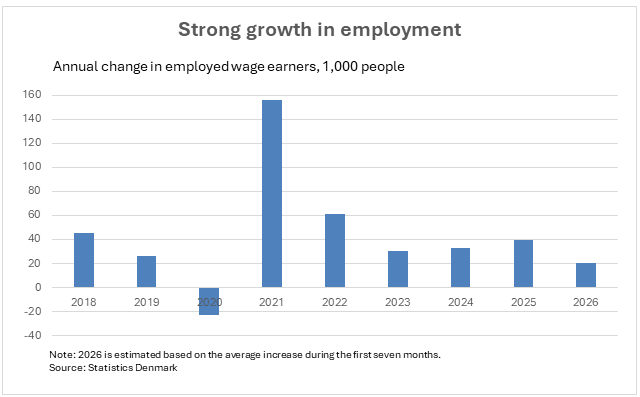
Over five years, wage-earner employment has increased by 235,000 people, and employment fell in only four of the past 60 months. Across those four months, the total decline in employment was 1,033 people. On average, employment has increased by 3,900 people per month over the past five years.
Continued Shortage of Labor
From December 2025 to May 2026, employers were unable to fill 49,600 jobs. In addition, 52,700 jobs were filled with candidates who did not meet all the desired qualifications. Apart from the COVID-19 years, both figures have remained stable since 2019.
The 292,000 additional jobs created between 2019 and 2026 have not increased the number of unfilled positions. Conversely, the additional 110,000 people aged 60–69 in employment and the 67,000 additional international employees who came to Denmark to work between 2019 and 2026 have not reduced the number of unfilled positions. Everything indicates that a larger supply of labor creates new jobs but does not ensure that vacancies can be filled. The reasons for unfilled jobs are primarily structural. For example, the figures show that the shortage of skilled workers is a substantial and growing problem. By contrast, the shortage of university-educated employees is declining, see Figure 2.
Figure 2
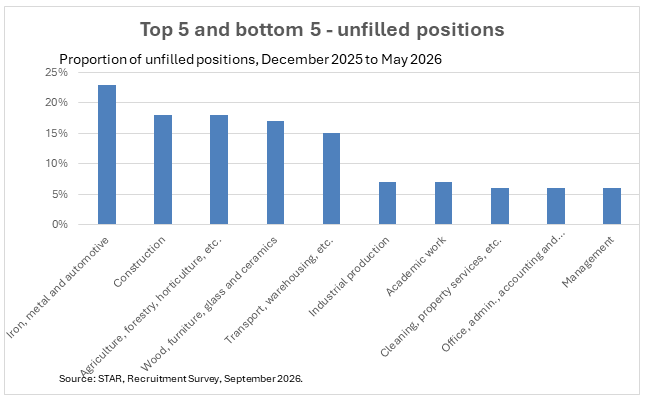
The Danish labor market has a structural problem. The shortage of primarily skilled workers will only become more severe unless businesses’ demand, particularly skilled workers, is met to a greater extent. This will affect collective bargaining and decentralized wage developments if solutions are not found to the shortage of employees.
A sustainable, long-term solution requires a greater shift in focus away from educating more young people and toward retaining skilled senior employees and creating a framework that enables more skilled international employees to come to Denmark.
An initial step may be the new certification scheme for international employees, which enters into force on January 1, 2027. However, the scheme is relatively complex, and the Government does not expect it to contribute to a large number of employees. There is a particular need for more skilled workers and therefore also for schemes for international employees that genuinely help fill the many vacancies. At the same time, businesses should contribute more actively by working strategically and consistently to retain and include skilled employees aged 60 and over.
The Capital Region of Denmark has the lowest proportion of unsuccessful recruitment attempts, at 10%. Region Zealand faces the greatest recruitment challenges, with 14% of recruitment attempts unsuccessful. This is likely connected with the high proportion of university-educated employees in the Capital Region, while Region Zealand, for example, has more production jobs, which often require skilled workers. Overall, there is a significant shortage of skilled workers.
More Vacancies
The number of vacancies on Jobnet.dk was high in September 2026. Between 2018 and 2026, the number was higher only in the COVID-19 years of 2021 and 2022. Since September 2025, the number of vacancies has increased by approximately 6,800, or 16%. See Figure 3.
Figure 3
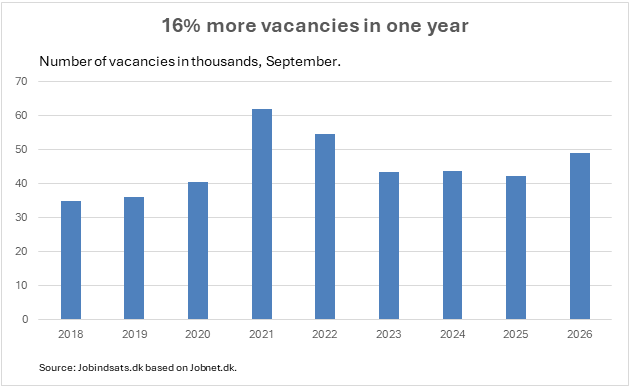
The municipalities with substantial growth in the number of vacancies are geographically dispersed across Denmark. Municipalities such as Hvidovre and Vesthimmerland have more than doubled their number of vacancies. Other municipalities with strong growth include Kerteminde, Lemvig, and Køge. The largest declines, of 20–30%, were recorded in Struer, Herlev, and Morsø.
Over the past year, the largest increase in vacancies was in construction, with 1,640 additional vacancies; transport, postal services, warehousing, and machine operation, with 1,500 additional vacancies; and iron, metal, and automotive work, with 940 additional vacancies.
Continued Growth in International Employees
From August 2025 to August 2026, the Danish labor market gained 8,700 international employees. This means people who are citizens of a country other than Denmark, work in Denmark, and hold a residence permit because of their employment, see Figure 4.
Figure 4
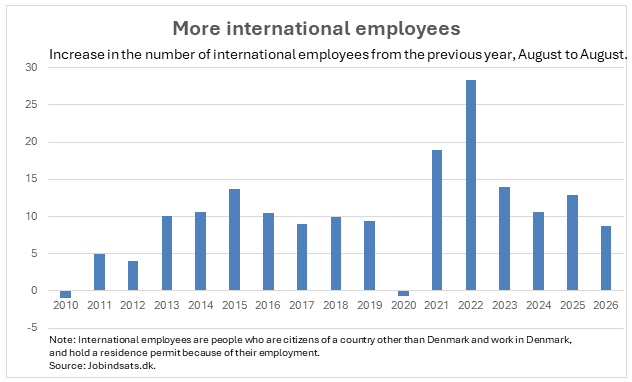
In most years since 2010, approximately 10,000 additional employees have come to Denmark from abroad. In 2026, Denmark has 175,000 more international employees than it did in 2010.
With employment expected to increase by approximately 20,000 people in 2026, but with only 8,700 additional employees from abroad, the labor market is drawing on the limited pool of unemployed people with a Danish background. In a labor market characterized by an aging workforce, continued employment growth may become difficult unless the labor force expands.
Highly Divergent Geographic Trends
The largest absolute increase in international employees was in Copenhagen, where 3,000 more now live than just one year ago. Other municipalities with substantial increases include Glostrup, with 721 additional international employees, and Vejle, with an increase of 439.
The largest absolute decline was in Gladsaxe, where the number of international employees fell by 1,005. The substantial decline in Gladsaxe is likely connected with the dismissal of employees at Novo. Other municipalities with substantial declines include Hørsholm (399) and Halsnæs (257).
Relative to the number of residents aged 18–69, the largest increase in the proportion of international employees occurred in Glostrup, Billund, and Brøndby. In Glostrup, the increase in international employees from 2025 to 2026 corresponds to 4.1% of residents, which is a very substantial increase in just one year.
By contrast, the proportion of international employees declined in Gladsaxe and Hørsholm by an amount corresponding to 2–3% of the municipalities’ population aged 18–69.
Fewer Employees from Poland
From August 2025 to August 2026, the number of Polish employees in Denmark fell by 670, while the number of Romanian employees increased by 1,274. Other countries with a marked rise in the number of employees in Denmark include Sweden and Iran, see Figure 5.
Figure 5
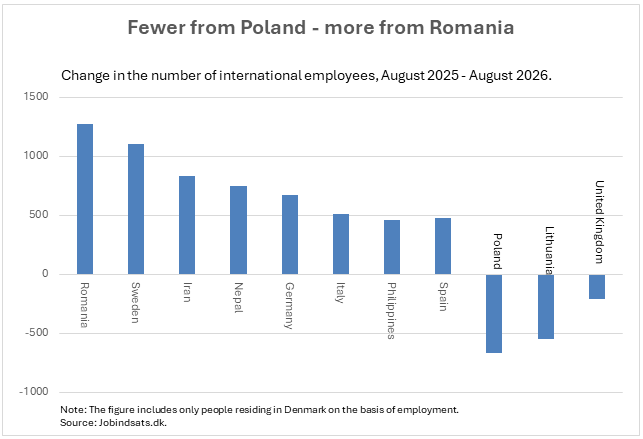
The decline in employees from Poland may indicate that the Polish economy is developing positively and that opportunities for attractive employment in their home country have therefore improved.
In the coming years, it will probably become more difficult to recruit employees from many Eastern European countries because their working-age populations will decline significantly. Against this background, the Danish Parliament has adopted a new route for people from outside the EU to come to Denmark for work: the so-called certification scheme. However, the Government estimates that the new scheme will contribute only 550 additional employees by 2030.
Relatively Few Major Redundancies
Businesses are required to give notice of major redundancies. Over the past 10 years, the number of employees covered by major redundancies has varied considerably, but remained at a relatively low level given Denmark’s approximately three million wage earners. In 2020, the number of notifications was higher because of uncertainty about the impact of the coronavirus. By 2021, that uncertainty had already diminished, and the number of major redundancies was therefore low, see Figure 6.
Figure 6
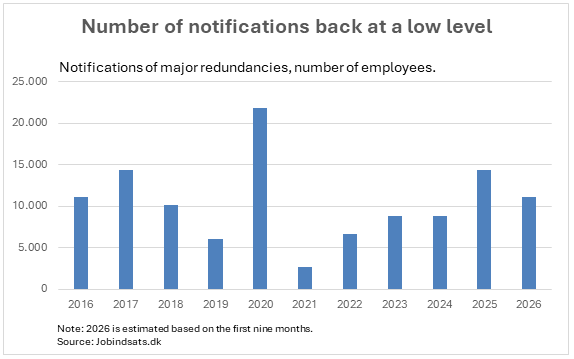
In recent years, the number of notifications has been at the same level as in 2016–2018.
Littler Comments
Businesses continue to need to retain their current employees and recruit new ones. Many jobs remain unfilled, and businesses are seeking more employees, particularly skilled workers. For many years, the two main ways of securing additional employees have been to retain more senior employees in employment and to attract more employees from abroad. The new certification scheme will provide access to attracting more skilled workers from non-EU countries, but it is far from sufficient to solve the structural problems in the Danish labor market caused by labor shortages in an aging population.
You can contact us here.
Disclaimer: The above is not, and cannot replace, legal advice.
____________________________________

Erik Simonsen
Senior Director
+45 44 14 30 96
